AOSNP-ADAPTR
Adapting Diagnostic Approaches for Practical Taxonomy in Resource-Restrained Regions
Objectives
- Build an optimal adaptation of the current WHO CNS5 classification, suitable for routine diagnostic practice in resource-restrained Asian-Oceanian settings.
- Ultimately benefit all patients with CNS tumors worldwide, especially at centers with resource constraints.
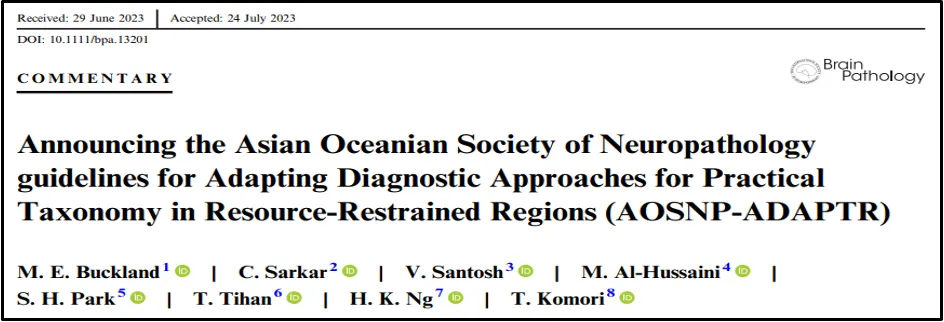
Key Components of ADAPTR Recommendations
- Identifying resource levels of diagnostic pathology services (RL I to V).
RL I
Histology only + special stains
RL II
+ Basic diagnostic IHC markers
RL III
+ Surrogate IHC molecular markers
RL IV
+ Basic molecular tests
(FISH, Sanger, PCR)
RL V
+ Advanced molecular tests
(NGS, DNA methylation profiling)
- Providing recommendations for ‘Histology-oriented integrated diagnosis’ for each tumor type at different resource levels
- Generating diagnostic flow charts that suit these resource levels.
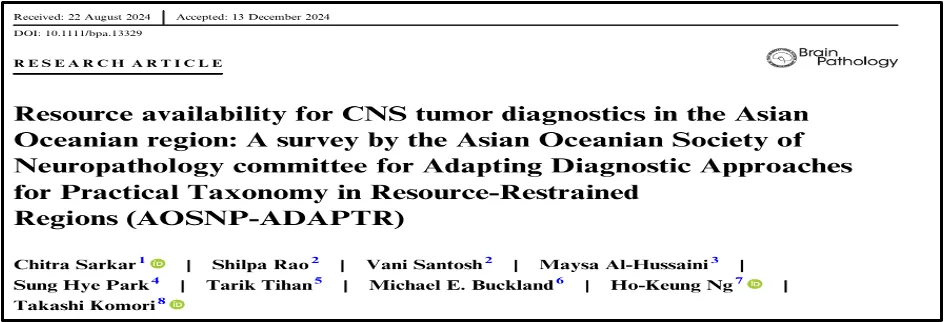
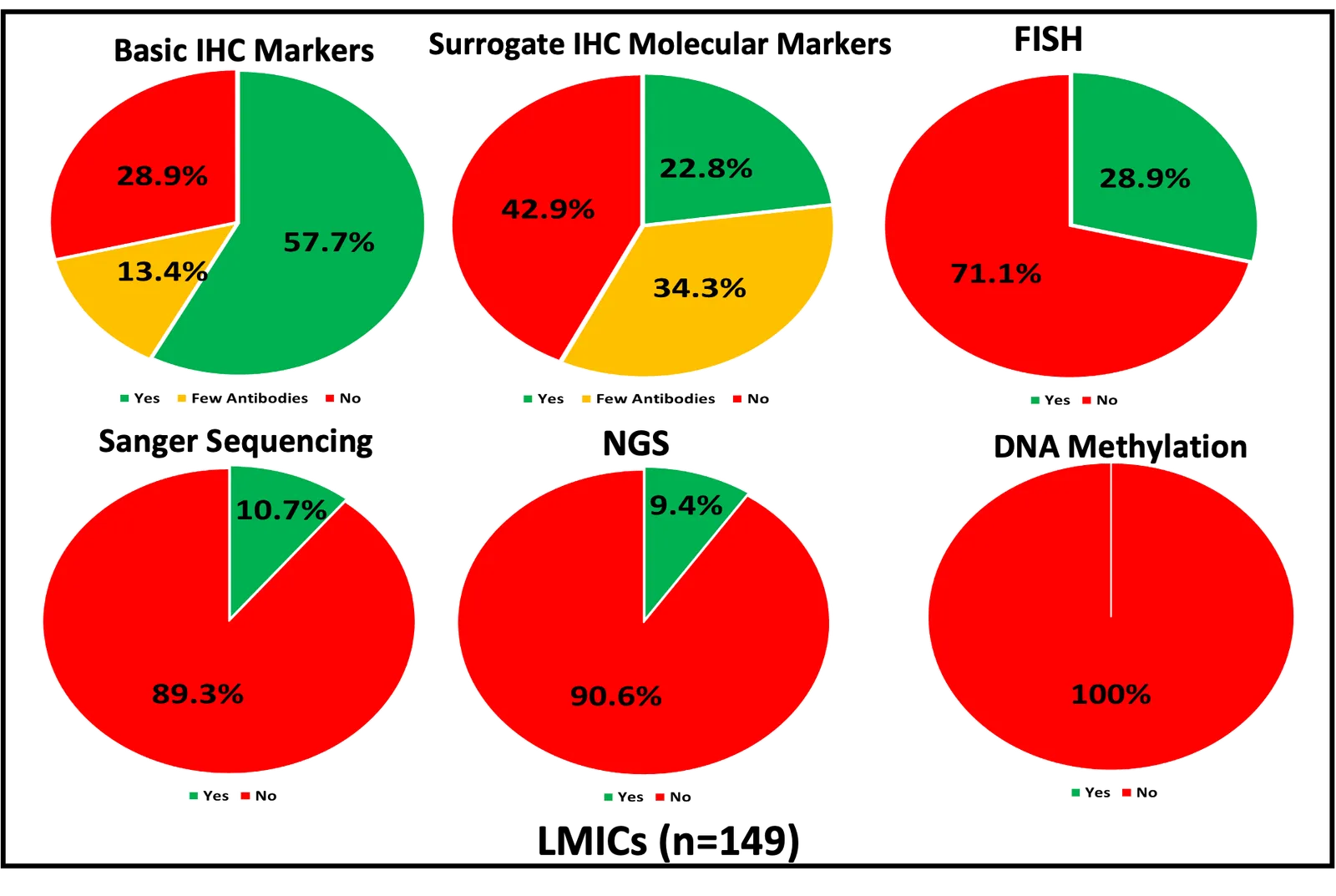
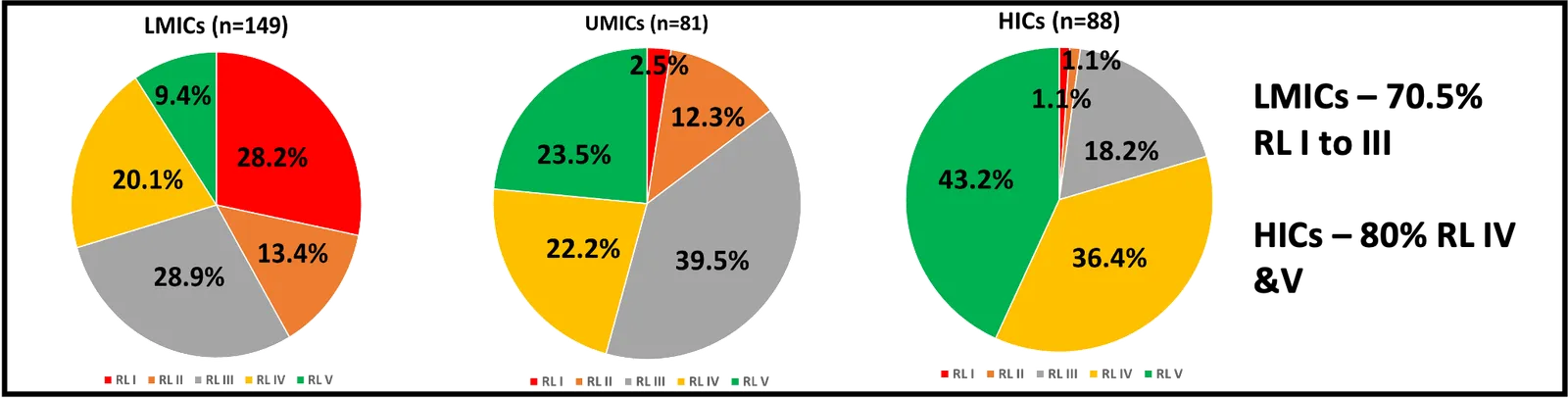
- Survey of 19 countries in the Asian Oceanian Region – 318 responding centers
- Revealed limited availability of in house/local diagnostic techniques, especially in LMIC respondent centers
Abstract
The fifth edition of the WHO classification of CNS Tumors (WHO CNS5) has revised the diagnostic and grading criteria for Adult-type Diffuse Gliomas (ADGs) by integrating molecular parameters with histologic features. Conducting molecular testing for most ADGs is now crucial in fulfilling the WHO CNS5 diagnostic criteria. However, due to additional costs and technical barriers, implementing molecular diagnostics is often not feasible in Low-Income Countries (LICs) and Lower Middle-Income Countries (LMICs). Therefore, practical approaches are needed for diagnosis in resource-restrained settings. Hence, the Asian Oceanian Society of Neuropathology (AOSNP), through the ‘ADAPTR’ (Adapting Diagnostic Approaches for Practical Taxonomy in Resource-Restrained Regions) initiative, aimed to provide resource-stratified recommendations for diagnosing ADGs based on available resources while adhering to the WHO guidelines as much as possible. ADAPTR identified different resource levels (RLs) of diagnostic pathology services, ranging from RL I to RL V, with RL I to RL IV being applicable to the LMICs, and provides recommendations for a ‘Histology-oriented integrated diagnosis format’ for each tumor type at different RLs. In addition, diagnostic flow charts for ADGs have been generated to suit these RLs. The emphasis is mainly on using histopathological approaches with immunohistochemistry, while molecular testing recommendation is categorised as ‘can be considered’, ‘highly recommended’ or ‘obligatory’, to reach the next level diagnosis. In each RL, either a WHO CNS5 diagnosis with an accompanying CNS WHO grade or an ADAPTR descriptive diagnosis with an associated ADAPTR histologic grade is provided, depending on the context. ADAPTR recommendations are therefore a practical adaptation of the WHO CNS5 guidelines that will suit routine diagnostic practices in resource-restrained regions.
AOSNP-ADAPTR TEAM
Steering committee
Chair:
Takashi Komori
Co-Chair:
Chitra Sarkar
Members:
Vani Santosh, Ho-Keung Ng, Michael Buckland, Maysa Al-Hussaini, Sung-Hye Park, Tarik Tihan
Advisory Board
International Neuropathology Advisors:
David N. Louis
Pieter Wesseling
Catriona McLean
Neuro-oncology Advisors:
Rakesh Jalali
Zarnie Lwin
Girish Chinnaswamy
Molecular Oncology Advisor:
Koichi Ichimura
Neurosurgery Advisors:
Yonehiro Kanemura
Neuroradiology Advisor:
Sona A. Pungavkar
Working Committees
Adult-type diffuse gliomas
Chair: Vani Santosh
Co-Chair: Ho-Keung Ng
Steering Member: Takashi Komori
Working Members: Shilpa Rao, Junji Shibahara, Hideaki Yokoo
Pediatric-type diffuse gliomas
Chair: Vani Santosh
Co-Chair: Sung-Hye Park
Steering Member: Tarik Tihan
Working Members: Se Hoon Kim, Yue-Shan Piao, Shilpa Rao
Circumscribed astrocytic glioma
Chair: Tarik Tihan
Co-Chair: Buckland M
Steering Member: Takashi Komori
Working Members: Sonika Dahiya, Se Hoon Kim, Yue-Shan Piao
Pediatric-type diffuse high-grade gliomas
Chair: Sung-Hye Park
Co-Chair: Maysa Al-Hussaini
Steering Member: Ho-Keung Ng
Working Members: Geeta Chacko, Sonika Dahiya, Shinya Tanaka
Ependymal Tumors
Chair: Michael Buckland
Co-Chair: Ho-Keung Ng
Steering Member: Vani Santosh
Working Members: Geeta Chacko, Kenta Masui, Junji Shibahara
Embryonal Tumors
Chair: Maysa Al-Hussaini
Co-Chair: Chitra Sarkar
Steering Member: Sung-Hye Park
Working Members: Yue-Shan Piao, Vaishali Suri, Hideaki Yokoo
General principles and diagnostic procedures
Chair: Takashi Komori
Co-Chair: Michael Buckland
Steering Member: Chitra Sarkar
Working Members: Kenta Masui, Vaishali Suri, Shinya Tanaka
The 20th International Congress of Neuropathology 2023, Berlin
AOSNP received official support from the International Society of Neuropathology (ISN), enabling it to host a symposium at the ISN Congress.
Scientific session - Neuro-oncology
- 15/09/2023
- 15:45 - 17:15
- Bernhard von Langenbeck (1st floor)
AOSNP Guidelines for Adapting Diagnostic Approaches for Practical Taxonomy in Resource-Limited Regions (AOSNP-ADAPTR)
Invited Talks
- Introduction: Chitra Sarkar (New Delhi, India)
- Adult diffuse gliomas: Vani Santosh (Bengaluru, India)
- Pediatric diffuse and circumscribed gliomas: Takashi Komori (Tokyo, Japan)
- Embryonal tumors: Maysa Al-Hussaini (Amman, Jordan)
- Ependymomas: Michael Buckland (Sydney, Australia)